SimInvest
Designing a decision-support tool for brokers to communicate the value of a capital guarantee on an investment in live client consultations.
Fintech
B2B2C


This case study is based on professional experience in a regulated enterprise environment. Visuals have been deliberately generalized, simplified. The content reflects my design approach and decision‑making.
Role
Product Designer (UI/UX)
Team
Project Manager (project initiation & requirements)
Developers (feasibility & implementation alignment)
Me
Platform
Desktop
Duration
4 months
Intro
Turning a communication problem into a decision-support tool
The product to sell consisted of pairing an investment to a capital guarantee - a financial protection that ensures investors receive back all or part of their original investment. Brokers were losing client confidence not because of a bad product, but because guaranteed investment outcomes were hard to explain clearly in a live advisory session.
I designed SimInvest, a decision-support tool that shifted consultations from one-way explanations to shared, scenario-based exploration.
Impact 1
Clarity and transparency increased
Clarity and trust improved due to the clear comparison between guarantee and non guarantee outcomes, and the use of natural language.
Impact 2
2-way conversation shift
From one-way explanation to shared, scenario-based exploration: "what does this mean?" became "what happens if…?"
Impact 3
Less preparation, more flexibility
Preparation time before consultations decreased, while flexibility and engagement increased due to live scenario adjustments.
Context
The problem
The value proposition of the product was the capital guarantee. Capital guarantees are genuinely difficult to communicate in a regulated advisory context to retail investors.
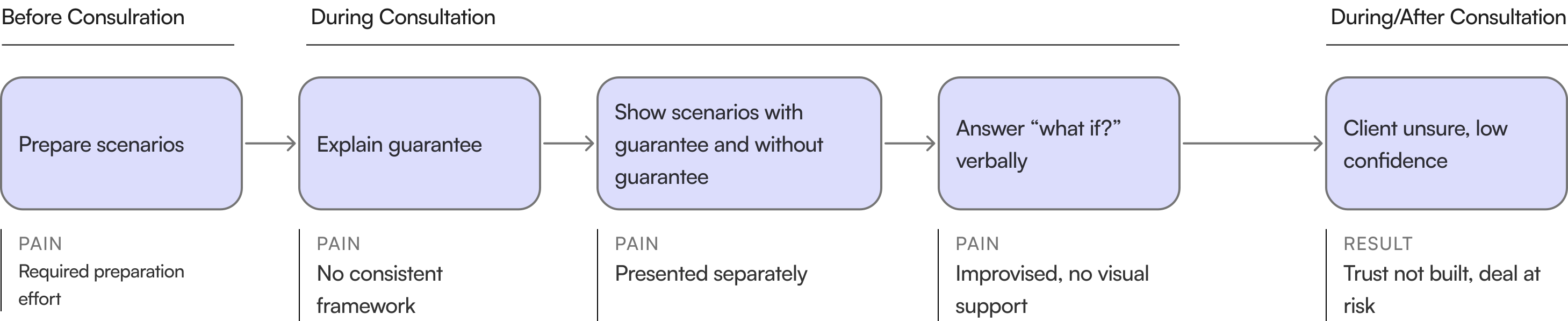
Based on a brief, together with the PM, I have investigated the broker consultation journey and I identified some pain points.
Broker consultation journey analysis
Main Findings
Finding 3
High preparation, low flexibility
Brokers prepared scenarios before the consultation, which was time-consuming and reduced flexibility during the session.
The problem wasn't the product: it was the absence of a clear visual reference during the conversation. Brokers and clients had no common ground to explore outcomes together.
My role
How have I solved it?
🕵️♀️ Discovery
I worked from a brief and collaboration with the PM to map how consultations broke down and where client understanding failed.
✏️ Design
I led concept development and direction, owning the interaction model and the feasibility dialogue with developers.
💬 Alignment
Close collaboration with PM, Brokers and Developers was relevant to combine different perspectives.
🚀 Validation
Before handoff, I ran informal sessions with two brokers to sense-check clarity and usability. Both responded positively to the comparison framework and the visual language.
Design direction
From insight to direction
The findings pointed directly to three design principles that became the foundation of the solution.
Outcome
What changed
Reflections
What I learned
Designing SimInvest reinforced that financial tools are fundamentally about trust.
In advisory contexts, clarity directly affects credibility and decision confidence, it is not just a usability goal.
This project strengthened my approach to designing systems that communicate complex technical concepts to non-specialist users, making them understandable and trustworthy.
What worked well ✅
Reframing under pressure
Pushing back on the "guaranteed/non-guaranteed framing" was the most impactful decision I made. That's what brokers pointed to as most valuable.
Effective cross-functional collaboration
Close collaboration with PMs and brokers brought together product, commercial, and client perspectives. This helped balance business constraints, usability, and trust.
What I'd do differently ❌
Involve end clients
The process was broker-led throughout, but I had no access to the end clients. For the future, I would involve them.
Establish clear success metrics
Due to project scope, no metrics have been implemented. For the future, I would establish some metrics to evaluate the success of the the concept, by measuring, for instance, the conversion rate.
Do you want to know more about it?
More case studies
